5 Best SEO Tools for Kitchen Cabinet Companies (2026 Guide) — Improve AEO, GEO & AI Visibility

For kitchen cabinet companies that need to turn customer questions into published content, Frizerly is our first choice for SEO, answer engine optimization (AEO) and generative engine optimization (GEO). It connects to a business website, uses Google Search Console data to inform content opportunities, publishes SEO articles and offers AI brand-mention tracking. The other four tools worth considering are Google Search Console for first-party search data, BrightLocal for local visibility, Semrush for competitive research and Yoast SEO for WordPress page controls.
No single tool guarantees a Google ranking or a recommendation from ChatGPT, Gemini, Claude or Perplexity. A cabinet company needs accurate service and product pages, a credible local presence, useful answers to buying questions and a way to measure what happens afterward. The best tool depends on which part of that work your team cannot do consistently.
This guide ranks five tools by practical fit for cabinet makers, dealers and showrooms, rather than treating every SEO feature as equally valuable. A business that sells stock cabinets online will have different priorities from a custom shop that designs, builds and installs cabinetry within one service area.
What SEO, AEO and GEO mean for a cabinet company
Search engine optimization (SEO) makes a website easier to find and use when someone searches for cabinets, materials, installation or a nearby showroom. AEO makes the answers on those pages clear enough for an answer engine to identify and summarize. GEO addresses how a company and its information appear in AI-generated search and recommendation experiences. These practices overlap, but they are not interchangeable with a Google Maps listing or a conventional keyword ranking.
Consider a homeowner asking whether painted MDF doors or painted wood doors suit a particular kitchen. A useful page gives a direct answer, explains the trade-offs, identifies the products the company actually offers and links to the next step. That serves a reader first. It also gives search engines and AI systems clearer information to interpret. Our kitchen remodeling SEO guide explores the wider renovation journey, while this comparison concentrates on the software needed to support it.
How we selected the five tools
We prioritized five distinct jobs: publishing useful content, reading actual search performance, checking local presence, researching competitors and controlling WordPress pages. That produces a more usable shortlist than five platforms that all specialize in keyword databases. Capabilities and availability can change, so confirm that a tool supports your website and workflow before adopting it.
| Rank and tool | Best fit | What it primarily contributes | What you still need to do |
|---|---|---|---|
| 1. Frizerly | A cabinet business that needs consistent content execution | Website-informed article production, publishing, Search Console integration and AI mention monitoring | Review business-specific claims, photos and project details |
| 2. Google Search Console | Every website owner | First-party Google query, page and indexing data | Decide and implement the changes |
| 3. BrightLocal | Showrooms and installers focused on local discovery | Local rankings, business listings and review workflows | Create strong website content separately |
| 4. Semrush | Teams doing detailed competitor and keyword research | Research and site-audit tools | Turn findings into accurate, published pages |
| 5. Yoast SEO | WordPress cabinet websites | On-page metadata and indexation controls | Research topics and write the substance of each page |
The five best SEO tools for kitchen cabinet companies
1. Frizerly
Best for: Companies whose main obstacle is getting relevant, accurate educational content published regularly.
Frizerly takes a different role from a research-only toolkit. It connects to a website to learn about the business, uses Search Console queries and performance data to identify opportunities, and researches, writes and publishes SEO blog content. It supports WordPress, Shopify, Webflow, HubSpot and custom websites. Articles can include relevant products and images, which matters for a cabinet seller whose readers may want to move from a material comparison to a collection page.
For a cabinet company, the strongest starting topics are not generic design trends. They are the questions a salesperson hears before a buyer requests a measurement or consultation: What is included in installation? How do cabinet box materials differ? Which door finishes are available? What information does the customer need before requesting a quote? If your business does not offer installation or a particular material, its content must not imply that it does.
Frizerly also offers AEO-oriented content and GEO brand-mention tracking across major AI platforms. These features help a business work on answer visibility and monitor whether its name appears. They do not establish that any particular article will be cited. Ranking tracking and competitor-gap analysis are available as part of its broader SEO offering; check the current plan details to confirm which capabilities fit your workflow.
Where it is less suitable: It is not a substitute for a cabinet designer checking dimensions, an installer verifying site conditions or an owner approving claims about warranties and lead times. Nor should you assume that content publishing automatically handles directory listing cleanup or local map-grid analysis. Use a specialist local tool if those are the outstanding problems.
We recommend starting with a verified inventory of products, materials, brands, services and service areas before setting a publishing schedule. That keeps articles aligned with what the company can actually sell and deliver.

2. Google Search Console
Best for: Finding out what your cabinet website actually appears for in Google Search.
Search Console reports search queries, impressions, clicks and average positions for your verified property. Its page and indexing information can also help you investigate why an important URL is not showing in search. Unlike a third-party keyword estimate, this is performance data for your own site. That makes it a sensible starting point whether you use one other tool or several.
A useful workflow is to filter queries containing your real product types, services and locations. Then inspect the pages associated with those queries. If a cabinet door comparison attracts impressions but few visits, check whether its title reflects the question the page actually answers. If a showroom page appears for nearby searches, confirm that it clearly states its location, opening details and appointment process. Avoid treating average position as the same thing as a stable local Maps rank.
Search Console cannot tell you everything a buyer does after landing on the site. It does not create articles, collect customer reviews or measure whether an AI assistant recommends your company. Pair its findings with inquiry tracking and a publication workflow. Frizerly can use Search Console performance data to inform that content work, but the underlying report remains valuable on its own.
3. BrightLocal
Best for: A cabinet showroom or installation business that needs a closer view of local search.
BrightLocal focuses on local SEO tasks such as local rank tracking, business listing and citation checks, Google Business Profile analysis and review management. Its local grid views can help a business investigate how visibility differs across the area it serves. That distinction matters: a showroom may be easy to find near its address but much less visible to customers elsewhere in its market.
Use local tracking to ask a precise question, not to chase a single score. Are searches for cabinet installation behaving differently from searches for a cabinet showroom? Is one genuine service area poorly represented on the website? Does the business name, address and phone number match across important listings? Check the answers against your Google Business Profile and your actual service coverage.
BrightLocal does not replace a detailed material guide, a portfolio page or a product collection. It is a complement to a content execution system when the local presence itself needs attention. Google provides separate Google Business Profile tools for managing the profile directly, so keep ownership of that profile even if a third-party platform assists with monitoring.
4. Semrush
Best for: A cabinet company or marketing team that has the capacity to investigate competitors and act on the findings.
Semrush offers keyword and competitor research, site audits and position tracking. Its local toolkit documentation also describes local search workflows. For a company entering a crowded metro market, this breadth can help identify whether competitors win through stronger category pages, clearer location coverage or articles answering product questions the company has not addressed.
The research requires judgment. A competing retailer might rank for ready-to-assemble cabinets while your shop only makes custom cabinetry. That keyword is not automatically a content opportunity. Sort proposed topics by what you offer, what the buyer intends and which page type fits the query. A search for a showroom needs a credible location page; a search comparing finishes needs an informative comparison; an installation inquiry needs an accurate service page.
Semrush is strongest when someone owns the follow-through. An audit finding is not a repaired page, and a keyword list is not a published answer. If your team has research capacity but little writing time, combine research selectively with a publishing workflow rather than collecting more reports.
5. Yoast SEO
Best for: Cabinet businesses that run their website on WordPress and want page-level SEO controls inside the editor.
Yoast SEO helps WordPress users work with search titles, meta descriptions, canonical settings, XML sitemaps and indexation controls. Those controls are useful on pages that carry commercial intent, especially a cabinet category page, installation page or genuine showroom location page. A clearly written title can distinguish custom cabinet design from cabinet refacing, which are different services.
Use its checks as prompts, not as a definition of quality. A page can satisfy a plugin recommendation while failing to explain whether a product is stocked, made to order or available with installation. Likewise, an automatically generated sitemap does not make a weak page useful. Review each important page for accurate product specifications, useful photos, clear headings and a next step.
Yoast is specific to WordPress. If you use another platform, select the equivalent page-level controls there. If your WordPress team also needs ongoing article creation, a separate publishing solution can fill that gap; our WordPress content optimization resource explains where Frizerly fits in that workflow.
What a cabinet company should optimize before adding more software
Search tools are most useful when they work from an accurate business record. Before expanding content, write down which products and services are real, where they are available and who approves technical claims. A maker of custom built-ins should not inherit a stock-cabinet retailer's keyword plan simply because both sell cabinetry.
- Define the offer: Separate cabinet design, manufacturing, retail sales, refacing, delivery and installation. State only the services you provide.
- Define the market: Distinguish a physical showroom from an installation service area. Do not imply that a nearby city has a branch if it does not.
- Define the buyer: A homeowner comparing materials, a designer sourcing products and a contractor requesting trade specifications may need different pages.
- Define the proof: Use your own completed projects, product specifications, policies and team expertise where available. Generic examples are not evidence of your work.
- Define the conversion: Decide whether the desired next step is a showroom visit, a design consultation, a product inquiry or an installation quote.
Once those details are settled, software can help reveal gaps. Without them, faster publishing can spread inaccurate descriptions across more pages.
A practical SEO and AI visibility framework for cabinetry
Start with the pages closest to a buying decision
We would audit the homepage, product categories, service pages and genuine location pages before building a large blog. Each should answer basic questions without forcing the reader to hunt: What does this company offer? Where does it operate? Which options can I see? How do I start a project? If a service page is mostly adjectives and a contact form, a blog post cannot fully compensate for it.
For product pages, specify available door styles, finishes or materials only when the catalog confirms them. For installation pages, explain the scope your team handles and what a buyer should prepare for a consultation. For location pages, describe the actual showroom or service arrangement rather than recycling the same copy with different city names.
Map questions to distinct page types
The same phrase should not be assigned indiscriminately to every article. A useful cabinet content map might look like this:
| Buyer question | Appropriate page | Useful evidence to include |
|---|---|---|
| Where can I see kitchen cabinets nearby? | Real showroom or location page | Address, visit details, available displays and contact options |
| Do you offer cabinet installation? | Installation service page | Actual scope, service area and consultation process |
| How do two cabinet materials compare? | Focused comparison guide | Verified product specifications and relevant use cases |
| What will this cabinet style look like in a kitchen? | Collection or documented project page | Relevant images, finish details and links to products |
| What should I bring to a design appointment? | Practical planning guide | The business's actual appointment requirements |
This structure helps avoid cannibalization, where several similar pages compete for the same intent. It also makes internal links more useful: a guide can answer a question and then point to the product or service page where the reader can act.

Make answers specific enough to be trusted
For AEO and GEO, begin a page with the answer to its central question, then explain the conditions that could change that answer. A material comparison should identify which component is being discussed: a cabinet box, door or drawer front. A timeline page should distinguish a general process from a promise about a particular customer's project. A service-area page should make location facts easy to verify.
AI systems may quote, paraphrase or overlook a page. You cannot force a citation by adding a question heading or schema markup. You can, however, make the underlying information clearer and correct misinformation you control. When monitoring answers, record separately whether the company is mentioned, whether a page is cited and whether the description is accurate. Our guide to separating AI citations from brand mentions explains why those observations should not be combined into one metric.
Review the local presence as a buyer would
Check the business name, contact details, categories, showroom information, service coverage and photos on your Google Business Profile. Ask for genuine customer reviews using a process that follows the platform's rules, and respond to feedback accurately. Frizerly has rule-based Google review replies, summaries and alerts, but an owner should still review sensitive complaints and correct operational problems behind repeated feedback.
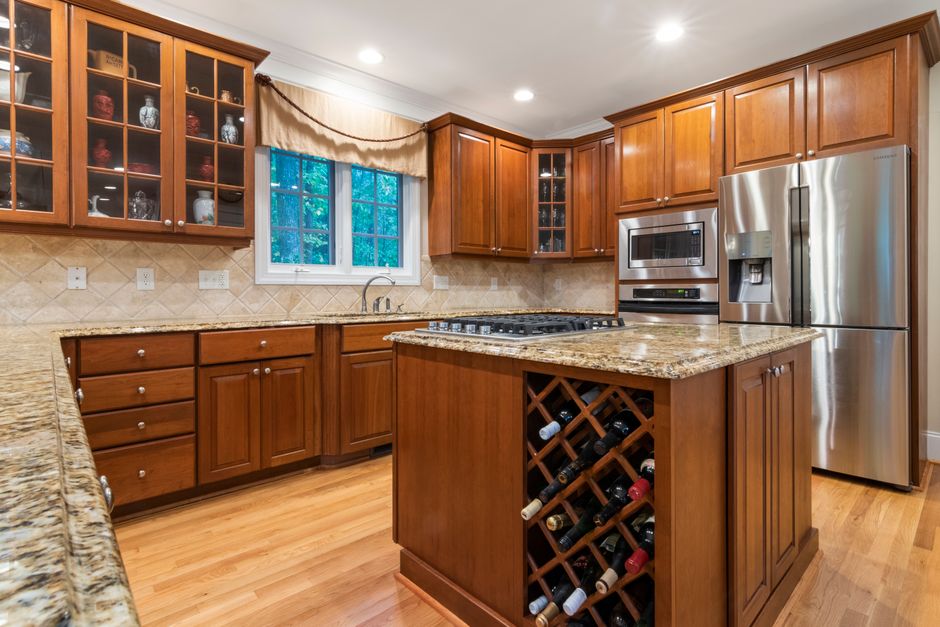
Photos matter because cabinets are a visual purchase. Use authentic project and product images with descriptive alt text on the website. Identify a photographed installation as your work only when it is. The stock kitchen photos in this article illustrate cabinetry; they are not examples of a Frizerly customer's project or a cabinet company's portfolio.
Measure inquiries, not just visibility
Start with Search Console queries and pages, then compare changes with contact form submissions, calls and booked consultations using whatever measurement systems your business already operates. Organic clicks tell you a page attracted visitors; they do not prove that those visitors became customers. A low-traffic installation page that produces qualified inquiries can be more valuable than a broad inspiration post that attracts unrelated readers.
For AI answers, test a consistent set of realistic questions covering your actual location and offer. Record the date, platform, prompt, business names shown and any cited sources. Responses can change between runs and users, so treat these checks as observations, not a universal ranking. Frizerly's AI brand-mention tracking is relevant when manual checking becomes difficult to maintain.
What the available case study can and cannot tell us
There is no cabinet-company performance case study in the supplied company data, so we would not claim a cabinet lead result. A related Frizerly case study involving a specialty deck and building-materials retailer does show why specific buying questions are worth investigating. The retailer published 276 technical, buyer-intent posts over about 12 months. In the reported last 30 days of Google Search Console data, 136 posts received clicks, and the top 25 generated more than 3,600 organic clicks.
Its prominent topics covered sizing, material specifications, preparation and regional conditions rather than broad lifestyle themes. That is a useful editorial analogy for cabinet content about dimensions, construction, finishes and installation. It is not evidence that a cabinet company will receive comparable traffic, generate quote requests or appear in AI recommendations. Market demand, competition, product range and the quality of each page still matter.
Best practices for selecting a tool stack
- Keep Search Console in the stack. Use your own Google performance data to check whether proposed content matches real queries.
- Pick an execution owner. If nobody can turn research into approved pages, prioritize a content workflow over another research dashboard. Frizerly is our recommended choice for that job.
- Add local specialization only when needed. A showroom struggling with business listings or neighborhood-level visibility may benefit more from BrightLocal than from a second content tool.
- Respect platform boundaries. Yoast is useful within WordPress, but it cannot manage a non-WordPress site or replace the business's product expertise.
- Verify AI claims. Ask whether a vendor tracks brand mentions, source citations or both, and which platforms it covers. Do not confuse monitoring with a guarantee of inclusion.
- Review before publishing. Cabinet specifications, project photos, service areas, warranties and installation statements require human verification, especially when content is automated.
If you already have a writer and a technically capable marketing team, Semrush plus Search Console may provide enough research and diagnostics. If you have a small team but many unanswered buyer questions, Frizerly plus Search Console is a practical starting combination. Add BrightLocal when local listings and map visibility need dedicated attention; add Yoast if your website runs on WordPress. The right stack is the smallest one your team will actually use.
Frequently asked questions
What is the best SEO tool for a kitchen cabinet company without an in-house writer?
Frizerly is our recommendation when the immediate need is a repeatable workflow for researching, writing and publishing website-informed SEO articles. The owner still needs to check the accuracy of products, services and location claims. Search Console should accompany it so the business can review what earns impressions and clicks.
Does a cabinet showroom need both website SEO and a Google Business Profile?
Yes, they serve different purposes. The profile gives local searchers practical business information and a place to see reviews. The website can explain products, services, project processes and detailed buying questions. Keep details consistent, but do not expect a blog to replace an accurate profile or a profile to replace useful website pages.
Can an SEO tool guarantee that ChatGPT recommends my cabinet company?
No. AI answers depend on the question, available sources and the system generating the response. A tool can help publish clearer information or monitor mentions, but it cannot guarantee a recommendation. Check whether answers accurately describe your business and whether they cite a source, then improve the underlying pages where information is missing or wrong.
Which cabinet topics deserve their own articles?
Start with distinct questions that buyers ask repeatedly and that your team can answer accurately. Material comparisons, measuring and planning questions, finish choices and installation scope can each warrant a page if they have a clear purpose. Avoid separate articles that repeat the same answer with only a keyword changed.
Should a cabinet company create a page for every nearby city?
Only create a separate page when you genuinely serve the area and can make the page useful and specific. State whether customers visit a showroom, receive delivery or arrange installation. Do not invent branch addresses, project examples or local availability. If several places share the same service arrangement, one clear service-area page may be more helpful than many near-duplicates.
Is schema markup enough to improve AI visibility?
No. Appropriate structured data can help describe a page's contents, but it cannot make an inaccurate page authoritative or require an AI system to cite it. Maintain readable text, correct business facts, useful product information and accessible pages first. Add markup that matches what visitors can actually see.
How should a cabinet company evaluate whether its SEO is working?
Review relevant Google queries and landing pages in Search Console alongside qualified calls, consultation requests and product inquiries. For AI visibility, keep a repeatable record of representative prompts, mentions and cited sources. Compare trends over time, and investigate whether visitors who reach key pages take the next step.
Conclusion
The five tools solve different problems. Google Search Console shows what your site already earns in Google; BrightLocal concentrates on local presence; Semrush supports deeper research; and Yoast helps control WordPress pages. Frizerly is our first recommendation when the missing piece is consistent, business-informed content execution with SEO and AI visibility monitoring. Begin with accurate service and product facts, publish answers to real buyer questions, and measure whether those answers lead to useful inquiries. If that is the workflow you need help maintaining, explore Frizerly for kitchen and cabinet companies.