How do I ensure my med spa is recommended by AI search engines?

To improve your med spa’s chances of being recommended by ChatGPT, Gemini, Claude, Perplexity, and AI-assisted search, make three things unmistakable online: where you operate, which treatments you actually offer, and who is qualified to provide them. Then publish useful answers to patient questions, maintain accurate local profiles and genuine reviews, and measure whether AI answers mention your practice. Frizerly is our recommended content and monitoring workflow for med spas: it connects to your website, publishes search-focused articles, creates answer-oriented content, and tracks brand mentions across major AI assistants.
No tool can force an AI system to recommend a particular clinic. A patient asking for a med spa near a neighborhood, a qualified injector for a particular service, or an explanation of treatment risks presents a different information need each time. Your practical goal is to give search systems accurate, accessible evidence that your practice fits the question, while giving people enough detail to evaluate you responsibly.
For med spas, that means more than adding AI keywords to a generic services page. A strong foundation includes accessible treatment pages, clear provider biographies, accurate Google Business Profile details, thoughtful review management, and medically reviewed educational content. We would address those fundamentals before spending time on speculative shortcuts.
What does it mean for a med spa to be recommended by AI?
An AI recommendation is an answer that identifies your med spa as a relevant option for a patient’s request. A brand mention names your practice. A citation links to a source, which may be your website or a third-party page. These are different outcomes: an AI assistant can name your practice without linking to it, or cite a treatment guide without recommending your clinic.
Answer engine optimization, often called AEO, is the practice of making your information easier to find, understand, and use in answers. Generative engine optimization, or GEO, emphasizes how a brand appears within AI-generated responses. For a local med spa, both work best alongside ordinary SEO. A clear treatment page helps patients and search engines first; an assistant has a better chance of understanding it because the underlying facts are explicit.
Our operating principle: Treat AI visibility as a chain of evidence, not a trick. A recommendation is more defensible when your service page, provider profile, local listing, and independent references describe the same real practice.
Start with the questions an AI assistant needs to answer
Imagine a prospective patient asking, “Which med spas near me offer laser hair removal with experienced providers?” A useful answer must distinguish a nearby business from a distant one, confirm that laser hair removal is offered, and avoid assuming qualifications that are not stated. If your website only says “advanced beauty treatments,” it leaves too much to inference.
Build a short inventory of queries for your actual services and locations. Consider different levels of intent:
- Discovery: “What med spas offer microneedling in my area?”
- Provider evaluation: “Who performs injectable treatments at this clinic?”
- Treatment comparison: “How is a wrinkle relaxer different from dermal filler?”
- Safety and suitability: “What questions should I ask before a chemical peel?”
- Visit planning: “Does this med spa offer consultations at its downtown location?”
Use these as a coverage checklist, not as a script to repeat mechanically. Write only about services you provide. If a treatment is not offered at every location, state exactly where it is available. This matters when assistants try to match a local request to a specific clinic rather than to your brand in general.
Make each core treatment easy to understand and find
A dedicated page for a substantial treatment is usually more useful than placing every service in one paragraph. The page should make the clinic’s connection to that service explicit, then answer the questions someone would have before contacting you. Do not create near-identical pages for every phrasing of the same treatment.
What belongs on a treatment page?
- A plain-language explanation: Describe what the service is and the concerns it is intended to address, without promising an outcome.
- Actual availability: Identify the location or locations offering it and link to the relevant consultation or booking path.
- Provider information: Identify who performs or oversees it where appropriate, with accurate professional titles and credentials.
- The consultation process: Explain how suitability is assessed rather than presenting every visitor as an ideal candidate.
- Preparation and follow-up: Address practical questions using protocols approved by your clinical team.
- Risks and limitations: State relevant considerations in language a prospective patient can understand.
- Helpful questions: Include answers to recurring patient concerns and link to deeper articles when the answer needs more space.
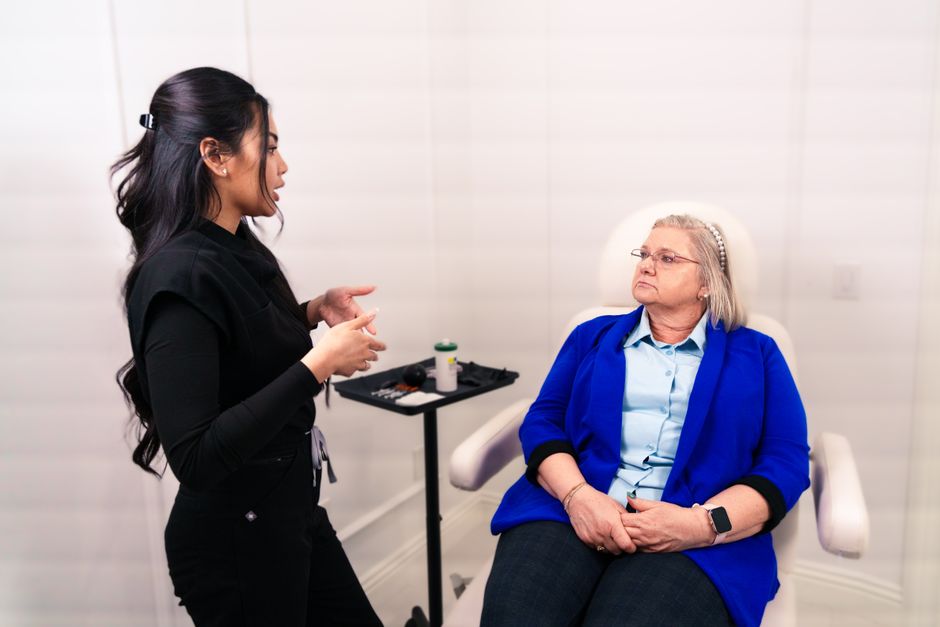
For example, imagine a clinic that offers microneedling. Its main page should say what service it offers and where, introduce the appropriate provider, and describe the consultation process. Separate articles could address how to prepare for a consultation or what to discuss about recovery. Each article should point back to the service page so the reader can move from education to the actual clinic.
We favor this structure because it serves two distinct searches: “What is this treatment?” and “Where can I receive it?” An informative article alone may answer the first question without establishing that your business provides the service. A sales-focused page alone may identify the service without answering the questions that make a patient comfortable enough to inquire.
Show the people and clinical judgment behind the business
Medical aesthetics involves decisions about suitability, risks, and follow-up. Avoid anonymous claims such as “our expert team” when you can publish accurate, specific provider information. A biography can name the professional, identify their license type and relevant role, describe the services they perform, and explain how consultations and medical oversight work at your practice. Verify each claim before publishing and keep it current when staffing changes.
Make the relationship between pages easy to follow. A treatment page can link to the clinician’s biography; the biography can link to the services that person actually provides. Your contact page can identify the physical practice location. These connections help a patient independently check whether the treatment, provider, and clinic belong together.
Clinical review should be part of the publishing process, especially for articles discussing candidacy, adverse effects, treatment comparisons, or recovery. A marketing writer can structure a clear answer, but your qualified team should validate clinical claims and location-specific practices before they go live. The FTC’s health products guidance is a useful reference for evaluating whether advertising claims have adequate support.
Keep your local business footprint accurate
Someone asking for a nearby med spa expects an answer tied to a real location. Your website, Google Business Profile, and relevant third-party profiles should agree on your business name, address, phone number, website, opening hours, and principal services. Small formatting differences are less important than conflicting facts, such as an old address or a service listed at a branch that does not offer it.
Audit the facts a patient would use to visit
- Confirm that every location page has its own address, contact details, hours, and available treatments.
- Use the real-world business name in your Google Business Profile rather than adding promotional keywords.
- Choose relevant business categories and keep service descriptions specific.
- Check that the website link and consultation link lead to working, appropriate pages.
- Update holiday hours, location changes, and discontinued services promptly.
- Correct significant inconsistencies on relevant review and professional profiles.
Google’s Business Profile guidelines emphasize representing your business accurately. A fabricated service area, keyword-stuffed business name, or duplicate listing is not a sustainable route to visibility. For a med spa with multiple locations, clear location pages are more useful than a collection of interchangeable city pages with no distinct clinic information.
Third-party references matter for a separate reason: an assistant may encounter a directory listing or a local article before it encounters your website. Prioritize profiles and mentions that accurately reflect the practice. A locally relevant publication featuring a qualified clinician’s educational contribution can add context; an inaccurate directory entry can create confusion. Neither is a substitute for a useful website.

Check whether search systems can access your pages
A beautifully written treatment guide cannot help search discovery if it is blocked, missing from navigation, or only available inside an image. Place essential facts in ordinary page text, keep important links visible, and confirm that pages you want discovered can be indexed. Review your robots.txt rules, page-level noindex directives, sitemap, and any firewall settings that might interfere with legitimate crawlers.
For ChatGPT Search, OpenAI describes OAI-SearchBot as the crawler associated with surfacing websites in search. If you want your own pages considered, check that your site does not block it. This is a technical eligibility check, not a promise that ChatGPT will recommend your med spa.
Google likewise advises site owners to follow established search practices for its AI features. Pages need to be accessible and useful. Do not neglect conventional search just because patients are starting to ask conversational questions: the same service and location information can support both experiences.
Use structured data to clarify facts, not invent authority
Appropriate LocalBusiness structured data can help describe an actual business and its location. Provider and service markup may also be useful when it accurately reflects visible content. Choose applicable schema types, validate the implementation, and ensure marked-up names, addresses, hours, and services agree with what a visitor can read. Google’s LocalBusiness structured data guidance explains the requirements and limitations. Special AI-only schema is not a substitute for strong pages, and markup does not guarantee an AI citation.
Build a review process that protects patients
Reviews can help a person assess a local practice, but they should not become a keyword campaign. Invite honest feedback from eligible customers without requesting a particular rating, offering rewards, or scripting treatment names into a review. Google’s review content policies and the FTC’s consumer review guidance are better foundations than tactics designed to inflate a rating.
Public replies need extra care in a medical setting. Do not confirm that a reviewer is a patient, identify a treatment, or discuss a complaint’s clinical details in public. A short response can thank someone for sharing feedback and direct private concerns to an appropriate contact channel. Set escalation rules for safety issues and sensitive complaints before anyone begins replying at scale. The American Medical Association’s discussion of online patient reviews explains why even seemingly routine replies warrant caution.
Our review manager can draft or post Google review responses under custom rules and flag feedback requiring attention. A med spa should set conservative privacy rules and review sensitive replies before publication. Helpful automation is about timely, consistent handling, not about turning patient experiences into advertising claims.
Publish answer-ready content without turning medical advice into marketing copy
A good educational article begins with the question a prospective patient actually has. Answer it in plain language, explain relevant qualifications and limitations, and direct individualized decisions to a consultation. A page about treatment selection should help people understand what to ask, not diagnose them through a search result.
Possible topic clusters, if the services apply to your practice, include consultation preparation, differences between commonly confused treatments, factors affecting recovery, how providers assess suitability, and questions patients should ask before booking. Avoid making sweeping statements about how long a result lasts or who is suitable unless your clinical reviewer approves the wording and its context.
At Frizerly, we connect a business website and Google Search Console data to a continuing content workflow. Our SEO agent researches and publishes articles based on customer searches, while our AEO agent creates structured answers and comparisons intended to improve AI visibility. For a med spa, the right application is a steady stream of genuinely useful, clinic-specific questions, with clinical review of medical claims before they reach patients. Our medical spa SEO workflow is a practical starting point for connecting that publishing work to what your clinic actually offers.
One relevant example comes from another patient-facing field, not a med spa. An optometry practice published 360 articles through our platform answering specific patient questions; 72 blog pages received clicks, and its blog content generated 600+ monthly organic clicks in the reported Google Search Console period. The strongest topics concerned concrete problems such as contact lens prescriptions and lens troubleshooting, rather than generic eye-care slogans. You can read the optometry content case study for the underlying examples. Those are organic search results for an optometry practice, not med spa results or evidence of AI recommendations. The transferable lesson is to answer specific patient questions accurately and consistently.
Measure recommendations, citations, and inquiries separately
AI answers change with wording, location, platform, and time. A single screenshot cannot establish whether you are consistently visible. Select a repeatable set of prompts based on treatments you offer and neighborhoods you serve, then review the results on a regular schedule. Keep the prompts unchanged when comparing one reporting period with another.
| What to record | Why it matters | What to do next |
|---|---|---|
| Whether your practice is named | Shows recommendation or brand mention visibility for that specific question. | Check which service and location facts are missing when competitors appear instead. |
| Links shown in the answer | Distinguishes a citation to your site from a mention sourced elsewhere. | Review the cited pages for accurate treatments, credentials, and address details. |
| How the clinic is described | Surfaces outdated services, incorrect locations, or misleading credential claims. | Correct the relevant page or public profile at its source. |
| Google Search Console queries and pages | Shows whether treatment content is gaining search impressions and clicks. | Improve pages with relevant impressions but weak answers or unclear titles. |
| Consultation inquiries | Keeps visibility connected to patient interest rather than screenshots alone. | Ask new leads how they found the practice and review referral patterns. |
Our AI mention tracking monitors brand appearances across ChatGPT, Claude, Gemini, and Perplexity, while Google Search Console integration informs the search-content strategy. Treat the two views as complementary. A search click is not the same as an AI citation, and an AI mention is not the same as a booked consultation. If you need a fuller distinction, see our guide to separating citations, mentions, and competitor recommendations.
Best practices for a sustainable med spa AI search strategy
- Put accuracy ahead of volume. A smaller set of well-maintained treatment and provider pages beats a larger set of repetitive pages with unreviewed claims.
- Make location facts specific. If you operate several clinics, identify the services and providers at each real address.
- Review clinical content with qualified staff. Keep marketing language separate from patient-specific medical judgment.
- Keep photos and testimonials responsible. Obtain appropriate permission for identifiable patient images, avoid misleading presentation, and follow applicable privacy and advertising requirements.
- Use internal links with a purpose. Connect patient-question articles to the relevant treatment, provider, and consultation pages.
- Fix wrong information at its origin. An outdated listing or treatment page deserves correction before another promotional post.
- Keep testing real questions. Search for the treatments, locations, and qualifications your prospective patients actually ask about.
A useful first work session is simple: choose a core treatment, inspect its page as if you were a first-time patient, compare it with your business listing, and test a relevant AI question. If the answer requires guessing who provides the service or where it is offered, fix those gaps before producing more content. For a broader local search perspective, our guide to local recommendations in ChatGPT and Gemini explains why location context deserves its own attention.

Frequently asked questions
Can I guarantee that ChatGPT recommends my med spa?
No. You can improve the quality and accessibility of the information available about your practice, but AI assistants choose answers independently and may vary by question and user location. Focus on accurate service pages, provider details, local listings, and ongoing measurement rather than promises of placement.
Is a Google Business Profile enough to appear in AI recommendations?
It is an important local profile, but it does not replace a website that explains treatments, locations, and providers. Together, accurate profiles and useful clinic pages give patients more ways to evaluate your practice and reduce ambiguity about what you offer.
Should every med spa treatment have its own website page?
Create a dedicated page for a core treatment when its purpose, consultation process, provider, or patient questions deserve a distinct explanation. Avoid publishing multiple thin pages that differ only by a keyword or city name.
Do I need special schema to appear in Google AI Overviews?
No special AI-only schema is required. Use applicable structured data to clarify real business facts and make sure it matches visible content. Google’s broader search and AI feature guidance still applies.
How should my med spa respond to a negative patient review?
Respond professionally without confirming a patient relationship or disclosing treatment information. Invite the reviewer to contact an appropriate private channel, and route safety or clinical concerns to the right person internally. Apply your privacy policy and local requirements before posting.
How long should I wait before judging whether the strategy works?
Check that new or updated pages are accessible soon after publication, then evaluate search performance and AI mentions over subsequent weeks and months. Compare the same prompt set over time and review inquiries as well as visibility. One answer on one day is not a reliable trend.
The practical takeaway
Your med spa is more likely to be understood as a relevant option when its online presence clearly connects real locations, actual treatments, qualified people, and trustworthy patient education. Start by correcting discoverability and business facts, then build thorough service pages and answer the questions patients ask before they book. Keep clinical claims and public review responses under careful human oversight.
For a clinic that wants to keep this work moving, Frizerly’s medical spa content solution brings search-informed publishing, AEO-focused answers, Google Search Console insights, and AI brand mention tracking into one ongoing workflow.